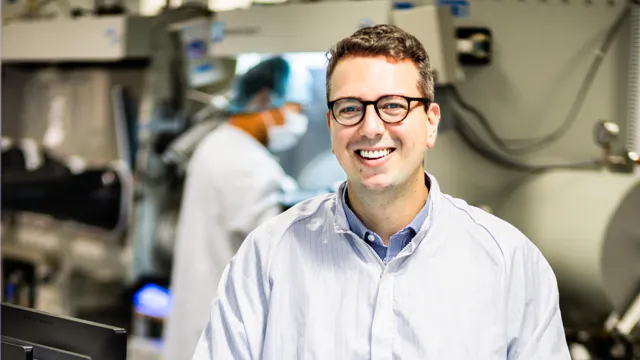
Researchers at the Laboratory of Organic Electronics at Linköping University have developed an organic composite material with unique properties – not only is it soft and stretchable, it also has a high electrical conductivity and good thermoelectric properties. This makes it ideal for many wearable applications.
The researchers have published the result in Nature Communications, together with colleagues from Belgium, New Zealand and California.
Nara Kim has carried out the research under the leadership of Professor Xavier Crispin and Senior Lecturer Klas Tybrandt, both at the Laboratory of Organic Electronics.
 The stretchable thermoelectric generator. Photo credit THOR BALKHED
“Xavier Crispin is a pioneer in organic thermoelectric materials; Klas Tybrandt is an expert in soft electronic materials; and I contribute my knowledge of organic composites. We came up with the idea for the new material together”, she says.
PEDOT:PSS is the most common conducting polymer and is used in many applications, not least due to its good thermoelectric properties. But thick polymer film is too hard and brittle to be successfully integrated into wearable electronics.
“Our material is 100 times softer and 100 times more stretchable than PEDOT:PSS”, says Klas Tybrandt, who leads the group of Soft Electronics at the Laboratory of Organic Electronics.
The new composite is also printable.
”The composite was formulated by water-based solution blending and it can be printed onto various surfaces. When the surface flexes or folds, the composite follows the motion. And the process to manufacture the composite is cheap and environmentally friendly”, says Nara Kim.
The researchers see a huge range of new possibilities using the material to create soft and elastic organic conducting materials.
“There are many ionic liquids, conducting polymers and traditional elastomers that can be combined to give new nanocomposites for many applications, such as thermoelectric generators, supercapacitors, batteries, sensors, and in wearable and implantable applications that require thick, elastic and electrically conducting materials”, says Xavier Crispin.
Principal financers of the research have been the Knut and Alice Wallenberg Foundation, the Göran Gustafsson Foundation and the Swedish Foundation for Strategic Research, together with the strategic research area in advanced functional materials, AFM, at Linköping University.
, Nara Kim, Samuel Lienemann, Ioannis Petsagkourakis, Desalegn Alemu Mengistie, Seyoung Kee, Thomas Ederth, Viktor Gueskine, Philippe Leclère, Roberto Lazzaroni, Xavier Crispin, and Klas Tybrandt, Nature Communications 2020, doi 10.1038/s41467-020-15135-w
Translated by George Farrants
The researchers have published the result in Nature Communications, together with colleagues from Belgium, New Zealand and California.
A totally new composite
Nara Kim, postdoc and principal research engineer in the Laboratory of Organic Electronics, has combined three materials: the conducting polymer PEDOT:PSS, a water-soluble polyurethane rubber, and an ionic liquid. The result is a composite with unique properties. The PEDOT:PSS gives it thermoelectric properties, the rubber provides elasticity, and the ionic liquid ensures softness.Nara Kim has carried out the research under the leadership of Professor Xavier Crispin and Senior Lecturer Klas Tybrandt, both at the Laboratory of Organic Electronics.
“Xavier Crispin is a pioneer in organic thermoelectric materials; Klas Tybrandt is an expert in soft electronic materials; and I contribute my knowledge of organic composites. We came up with the idea for the new material together”, she says.
PEDOT:PSS is the most common conducting polymer and is used in many applications, not least due to its good thermoelectric properties. But thick polymer film is too hard and brittle to be successfully integrated into wearable electronics.
“Our material is 100 times softer and 100 times more stretchable than PEDOT:PSS”, says Klas Tybrandt, who leads the group of Soft Electronics at the Laboratory of Organic Electronics.
Printable onto various surfaces
”The ability to control the structure of the material both at the nanoscale and the microscale allows us to combine the excellent properties of the different materials in a composite”, he says.The new composite is also printable.
”The composite was formulated by water-based solution blending and it can be printed onto various surfaces. When the surface flexes or folds, the composite follows the motion. And the process to manufacture the composite is cheap and environmentally friendly”, says Nara Kim.
The researchers see a huge range of new possibilities using the material to create soft and elastic organic conducting materials.
“There are many ionic liquids, conducting polymers and traditional elastomers that can be combined to give new nanocomposites for many applications, such as thermoelectric generators, supercapacitors, batteries, sensors, and in wearable and implantable applications that require thick, elastic and electrically conducting materials”, says Xavier Crispin.
Principal financers of the research have been the Knut and Alice Wallenberg Foundation, the Göran Gustafsson Foundation and the Swedish Foundation for Strategic Research, together with the strategic research area in advanced functional materials, AFM, at Linköping University.
, Nara Kim, Samuel Lienemann, Ioannis Petsagkourakis, Desalegn Alemu Mengistie, Seyoung Kee, Thomas Ederth, Viktor Gueskine, Philippe Leclère, Roberto Lazzaroni, Xavier Crispin, and Klas Tybrandt, Nature Communications 2020, doi 10.1038/s41467-020-15135-w
Translated by George Farrants