Limited knowledge
One problem in saving energy is a lack of knowledge about energy consumption in different processes. Knowledge is currently available about the use of energy in different sectors and different industries, and in some cases at the level of a facility. However, we have little information about processes and individual machines. This makes it difficult to compare different operations and assess the potential for various energy-saving measures.
In his thesis, Enabling industrial energy benchmarking: Process-level energy end-use, key performance indicators, and efficiency potential, Elias Andersson attempts to solve this very problem. He asks whether it is possible to define a number of processes and determine key indicators for their energy consumption.
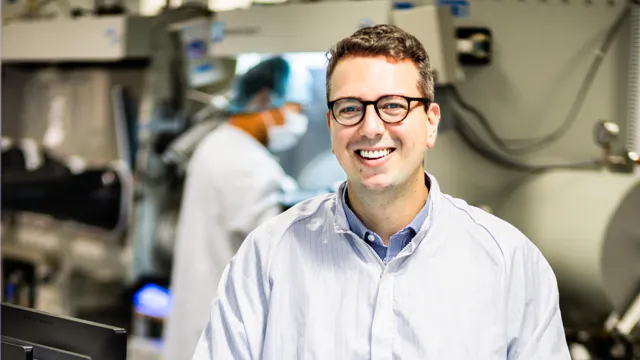
Elias Andersson outside A-building, LiU, Campus Valla.
The thesis mainly describes investigations of companies in the wood industry and the pulp and paper industry, but the methods derived can be applied in other manufacturing industries.
鈥淲e need more detailed information about energy consumption in different processes. Without it, it is not possible for companies, politicians or official bodies to assess the potential of different measures and their cost effectiveness. In the worst case, there鈥檚 a risk that we concentrate on completely the wrong things鈥�, says Elias Andersson.
Several processes
The thesis defines ten production processes in the wood industry such as, for example, drying, sawing and various types of finishing treatments of timber. The number of processes in the pulp and paper industry is larger. In the next step, Elias Andersson connects these processes to various key energy indicators.
In the simplest case, such key indicators can be the energy consumption per unit, measured in weight or volume. It can also be, for example, the energy required per kilogramme of water evaporated from the timber when it is dried.
鈥淚n this case, the fact that different types of wood contain different amounts of water comes into consideration. This is exactly the problem when using key indicators of this type: The differences between raw materials and their qualities must be considered鈥�, says Elias Andersson.
Without detailed information at the level of the process, measures to save energy often target the operation that requires most energy, quite simply. This is often what happens today. In the wood industry, this is often the ovens used to dry the timber, while in the pulp and paper industry it is the processes used to recycle chemicals.
Larger potential
The results presented in the thesis suggest that other processes may have significantly larger potential. This is the case for, for example, process ventilation in the wood industry, the process in which sawdust is extracted.
鈥淚鈥檓 not claiming that the companies are currently doing the wrong things, but we can鈥檛 be sure that what they do is the absolute best. This knowledge increases the probability that the measures taken are as cost effective as possible鈥�, says Elias Andersson.
Information is one important driving force for saving energy, but not the only one. Other factors are the availability of resources, financing, requirements from official bodies, and customer demand. The approach and commitment of the company also play a huge role, of course.
鈥淚t鈥檚 difficult to compare factors, but knowledge is definitely an important one鈥�, says Elias Andersson.
A special method
The thesis presents an assessment showing that the possible savings in energy are huge: the wood industry alone could save 1,100 GWh per year (which is 13-14% of the total consumption of the industry). In terms of impact on the climate, this corresponds to a reduction in carbon dioxide emission of between 150,000 and 370,000 tonnes per year.
A further question concerns the best way to introduce these key energy indicators, once they have been defined. The thesis suggests a special method for the implementation in the pulp and paper industry. It emphasises the importance of continuous follow up, visualisation, and the regular revision of the key indicators.
Translated by George Farrants