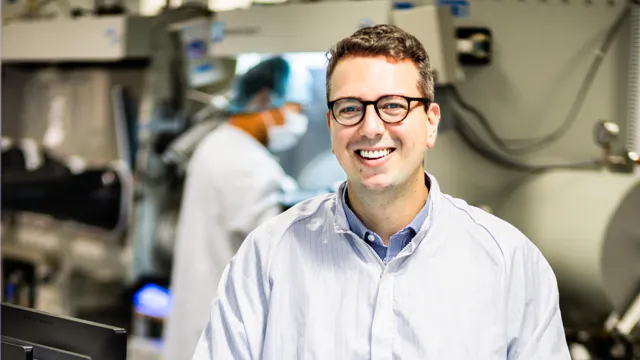
鈥淭o enable the full potential of organic solar cells to be exploited, there is a need for a clear picture of how they work. We have now obtained that picture. This provides a better understanding of how to create new efficient and sustainable solar cell materials,鈥� says Mats Fahlman, Mats Fahlman, a professor at the Laboratory of Organic Electronics at Link枚ping University. Photo credit Thor Balkhed a professor at the Laboratory of Organic Electronics at Link枚ping University.
Today, solar energy meets around two percent of the world's energy needs. But its potential is far in excess of that. The energy contained in the sun's rays is more than enough to meet our needs today and in the future. Solar cells that are cheap and environmentally friendly to manufacture are needed to be successful. In addition, they need to be efficient at absorbing a large proportion of the sun's rays and converting to electrical energy.
Sustainable
Organic solar cells based on organic semiconductors are increasingly emerging as a sustainable option. But until just a few years ago they could not stand comparison with traditional silicon-based solar cells for efficiency. This was due to energy loss in charge separation, which was thought to be unavoidable.
Xian鈥檈 Li and Qilun Zhang are PhD students at the Laboratory of Organic Electronics and have lead the study. Photo credit Thor Balkhed But in 2016, a research team at Link枚ping University together with colleagues in Hong Kong were able to show that it was possible to avoid the energy loss using different donor-acceptor materials that help the electron to escape from its hole more easily. Energy loss then decreased and efficiency increased. The problem was that no one knew exactly how it happened. It was possible to see that it worked, but not why.
"Like a strawberry and cream cake"
Some of the same research team at Link枚ping University have now solved the mystery that had led to disagreement in this field of research. In a new study published in Nature Communications, the researchers have identified what energy levels are required to minimise energy losses.
鈥淭o find out how the energy flows, we laid nanometre-thick organic semiconducting films in several layers one on top of the other, rather like a strawberry and cream cake. After that we measured the energy required to separate the electrons from their holes in each individual layer,鈥� A sample of conductive polymer. Photo credit Thor Balkhed says Xian鈥檈 Li, a PhD student at Link枚ping University and principal author of the scientific article.
The researchers were then able to map the mechanism behind the energy-efficient charge separation. This systematic mapping points a new way forward for the development of organic solar cells.
The study is funded by the Swedish Research Council, the Swedish Energy Agency and the Swedish Government's strategic initiative Advanced Functional Materials at Link枚ping University.
The article: Xian鈥檈 Li, Qilun Zhang, Jianwei Yu, Ye Xu, Rui Zhang, Chuanfei Wang, Huotian Zhang, Simone Fabiano, Xianjie Liu, Jianhui Hou, Feng Gao & Mats Fahlman Nature Communications 13 2022 doi: 10.1038/s41467-022-29702-w
Footnote: The organic solar cells in the study are of a type where the electron acceptor is made of a material other than fullerene (a form of carbon), which previously was the most common material used. Non-fullerene-based organic cells become more stable and are capable of absorbing a greater proportion of the sun's rays for conversion to energy.
Xian'e Li, PhD student at Link枚ping university. Photo credit Thor Balkhed