In what ways does modern technology risk giving us a distorted picture of the world? And can this problem be resolved? These are issues at the intersection of social science and technology. Seeking answers to the questions above, researchers at Tema Genus (Gender Studies) are working with colleagues in computer science.
Photographer:
Jenny Widén
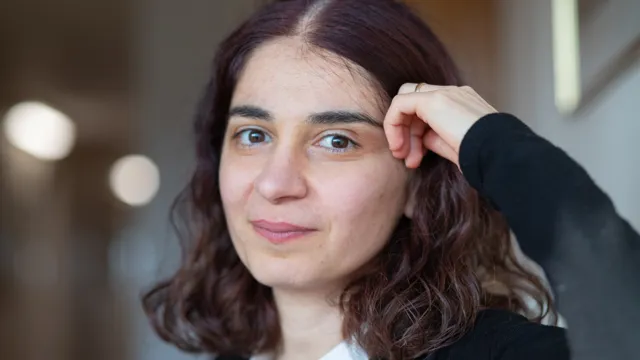
Social scientists Katherine Harrison och Ericka Johnsson collaborate with computer scientists.
鈥淎 lot of what we are trying to achieve can potentially change the power structures in society,鈥� says Professor Ericka Johnson, a social scientist with an interest in the consequences of technology.
She and her colleagues Associate Professor Katherine Harrison and postdoc Tahereh Dehdarirad are seated at a table in Tema Genus in Link枚ping. Together, they are trying to describe that borderland where technology and social sciences meet and are influenced by each other.
Research at Tema Genus concerns power relations in society and the interaction of various factors, often with a focus on gender and gender identity, but also on aspects such as ethnicity and global inequality. They assert that technology is not independent of those relations but is always embedded in a context.
Risk of cementing injustice
Our conversation turns to the problem of the data used to train an AI. Such data can be incomplete in different ways. A well-known example is how medical studies have long been conducted more often on men than on women, and therefore the data is not representative. Another problem is that large amounts of relevant data cannot be used because it contains sensitive personal data or is kept secret by private companies.
As a consequence, AI may contribute to cementing ignorance, injustice and prejudice.
One solution that Ericka Johnson and Katherine Harrison are interested in is what is known as synthetic data. It is created using AI to statistically mimic the characteristics and patterns of real data.
As the synthetic data is similar but not identical to real data, you can get around the privacy problem. It could also be used to artificially create the huge amounts of data needed to train an AI if there is not enough real data. Or be added to material that, for example, contains too few women.
鈥淥ne idea that is currently being discussed is whether synthetic data could be used in the social sciences. But some scientists are very sceptical,鈥� says Katherine Harrison.
Tahereh Dehdarirad, postdoc at Gender Studies at LiU.Explaining AI
So, if the beauty of synthetic data is that it is similar but not identical 鈥� how different can the original be and still be useful? And how do you ensure that biases in the original material are not repeated in the synthetic material?
Tahereh Dehdarirad embodies the meeting between two branches of science. She is a social scientist who is also a computer scientist. Simply put, part of her research is about explaining how an AI arrives at its answers. This is called explainability in AI.
鈥淲e want to identify skewed data and then create synthetic data that corrects this,鈥� explains Tahereh Dehdarirad.
What is selected or deselected
Now to the Division for Media and Information Technology in Norrk枚ping and Professor Miriah Meyer, who researches data visualisation. She has collaborated with biologists, meteorologists, health experts and even poets to help them create images of their results. This got her thinking. The images may be clear and powerful, but do they give a true picture of the world?
Professor Miriah Meyer at the Division for Media and Information Technology.Photographer: Jonas Roslund鈥淲hat we are creating is not an objective picture of data. It鈥檚 based on what I think is important to show, which in turn is influenced by how I was taught,鈥� says Miriah Meyer.
But what happens to uncertainties in the material when it is visualised? What is selected and what is deselected? And why?
These are things that she has been discussing with her colleagues at Tema Genus for several years. Next year, she and Katherine Harrison will be teaching together. Students from the humanities and social sciences, together with engineering students, will get to look at these questions from several aspects. But Miriah Meyer also wants to challenge them to come up with suggestions on how to deal with data difficulties.
Friction at the intersection of disciplines
Even though she very much appreciates the many critical questions posed by social scientists, Miriah Meyer can sometimes get a little frustrated that they present fewer suggestions for solutions. And at meetings she often feels compelled to defend her own field of science. Despite the problems, technology and science have nevertheless led to great progress.
And at Tema Genus, it is agreed that it is not easy when different scientific traditions meet. Natural science requirements that results must be objective, repeatable and generalisable are at odds with social science鈥檚 conviction that knowledge is always situated and related to values in society.
鈥淚t鈥檚 a challenge! We need to be very transparent about what we mean by our different concepts, because the terms used sometimes mean different things to us. But we鈥檝e been very lucky to find partners who have been curious and very open to letting us into their world,鈥� says Katherine Harrison.