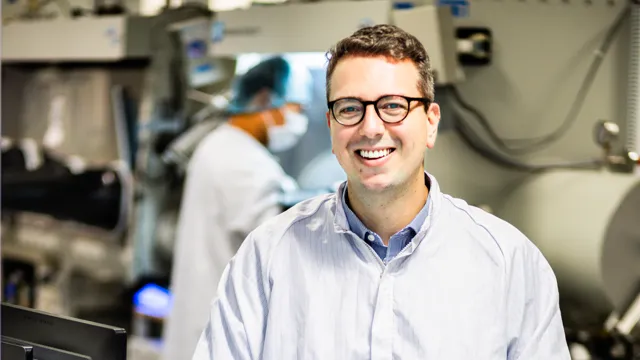
“Magnesiumdiboride or MgB2 is an interesting material. It’s a hard material that is used for instance in aircraft production and normally it becomes superconductive at a relatively high temperature, 39 K, or -234 C°”, says Erik Johansson, who recently completed his doctorate at the Division of Theoretical Physics.
Erik Johansson is also principal author of an article published in the Journal of Applied Physics that have attracted broad attention. The results have been identified by the editor as particularly important for the future.
“Magnesium boride has an uncomplicated structure which means that the calculations on the supercomputers here at the National Supercomputer Centre in Linköping can focus on complex phenomena like superconductivity”, he says.
If the scientists are successful in increasing the critical temperature, there will be greater opportunities to use the phenomenon of superconductivity in practical applications.
 Erik Johansson“The main goal is to find a material that is superconductive at normal pressure and room temperature. The beauty of our study is that we present a smart way of increasing the critical temperature without having to use massively high pressure, and without using complicated structures or sensitive materials. Magnesium diboride behaves in the opposite way to many other materials, where high pressure increases the ability to superconduct. Instead, here we can stretch the material by a few per cent and get a huge increase in the critical temperature”, says Erik Johansson.
The discovery of this phenomenon paves the way for calculations and tests of other similar materials or material combinations that can increase the critical temperature further.
 Björn Alling Photo credit Charlotte Perhammar“One possibility could be to mix magnesium diboride with another metal diboride, creating a nanolabyrinth of stretched MgB2 with a high superconductive temperature”, says Björn Alling, docent and senior lecturer at the Division of Theoretical Physics and director of the National Supercomputer Centre at Linköping University.
The research has been funded by the Knut and Alice Wallenberg Foundation, the Swedish Research Council and the Swedish Foundation for Strategic Research, among others. It has been conducted with support from the government’s strategic venture, Advanced Functional Materials, AFM, at Linköping University.
The article:
—Benchmark of theoretical methodologies and outlook for nanostructure design, Erik Johansson, Ferenc Tasnádi, Annop Ektarawong, Johanna Rosén, and Björn Alling. Applied Physics 131, 063902 (2022); doi: 10.1063/5.0078765
Erik Johansson is also principal author of an article published in the Journal of Applied Physics that have attracted broad attention. The results have been identified by the editor as particularly important for the future.
“Magnesium boride has an uncomplicated structure which means that the calculations on the supercomputers here at the National Supercomputer Centre in Linköping can focus on complex phenomena like superconductivity”, he says.
Superconductivity
Access to renewable energy is fundamental for a sustainable world, but even renewable energy disappears in the form of losses during transmission in the electrical networks. These losses are due to the fact that even materials that are good conductors have a certain resistance, resulting in losses in the form of heat. For this reason, scientists worldwide are trying to find materials that are superconductive, that is, that conduct electricity with no losses at all. Such materials exist, but superconductivity mostly arises very close to absolute 0, i.e. 0 K or -273,15 °C. Many years of research have resulted in complicated new materials with a maximum critical temperature of maybe 200 K, that is, -73 °C. At temperatures under the critical temperature, the materials become superconductive. Research has also shown that superconductivity can be achieved in certain metallic materials at extremely high pressure.If the scientists are successful in increasing the critical temperature, there will be greater opportunities to use the phenomenon of superconductivity in practical applications.
Increased critical temperature
In the nanoscale, the atoms vibrate even in really hard and solid materials. In the scientists’ calculations of magnesium diboride, it emerges that when the material is stretched, the atoms are pulled away from each other and the frequency of the vibrations changes. This means that in this material, the critical temperature increases – in one case from 39 K to 77 K. If magnesium diboride is instead subjected to high pressure, its superconductivity decreases.The discovery of this phenomenon paves the way for calculations and tests of other similar materials or material combinations that can increase the critical temperature further.
The research has been funded by the Knut and Alice Wallenberg Foundation, the Swedish Research Council and the Swedish Foundation for Strategic Research, among others. It has been conducted with support from the government’s strategic venture, Advanced Functional Materials, AFM, at Linköping University.
The article:
—Benchmark of theoretical methodologies and outlook for nanostructure design, Erik Johansson, Ferenc Tasnádi, Annop Ektarawong, Johanna Rosén, and Björn Alling. Applied Physics 131, 063902 (2022); doi: 10.1063/5.0078765